My WhatsApp Channel
https://whatsapp.com/channel/0029VbE50z43mFY49bAeLp1B/101
1
Over the years, I have been writing little notes and collecting thoughts, words and ideas that inspire me. Especially during moments when I feel low or need a little inner strength.
In a way, this collection has become my own little Gita — not a scripture, but a collection of things that have touched my heart, made me pause, reflect and look at life differently.
These are thoughts that have helped me grow, mentally and spiritually. Some have come from books, some from conversations, some from experiences, and some from simply observing life.
I thought I would share them here. Perhaps something that has touched my heart may touch yours too.
Welcome to this little space of reflection and growth. ❤️
2
When depression knocks upon your door, don’t open it.
Shoot the bolt and turn the key, for if you should admit the visitor into your house you will very soon repent, for where he is, you’ll find no hope no joy no merriment .
He has shocking manners, for he stays and stays and stays, can’t get rid of him at all, a call may last four days. For once he is in, he makes himself at home and there’s no doubt that in the end the only thing to do is to kick him out.
So be warned. For he’s a thief, he’ll steal the things you prize, peace and sweet contentment, in his presence beauty dies.
Nothing seems to be worthwhile, he’ll wear you to a shred, haunt you when you sit alone and follow you to bed.
If you feel that he’s about lock doors and windows fast, give yourself a job to do until the danger is passed. Then in time he’ll tire of seeking you out without success and will leave you free to live in perfect happiness.🙏
3
I guess we all are worriers. So I love this poem which comes from ‘roses for remembrance by Patience Strong.
Why worry worry night and day?
When all you have to do is kneel and pray? Why worry when the power of prayer is yours to move the mountains and to open doors?
Knock said the master, ask and you will receive. His words are clear and plain but few believe the faith is lacking and we are afraid,
of trying out the promises He made. We strain and struggle growing tired and Old, the hand that’s offered we refuse to hold .
We go on worrying our lives away, instead of learning how to trust and pray.
4
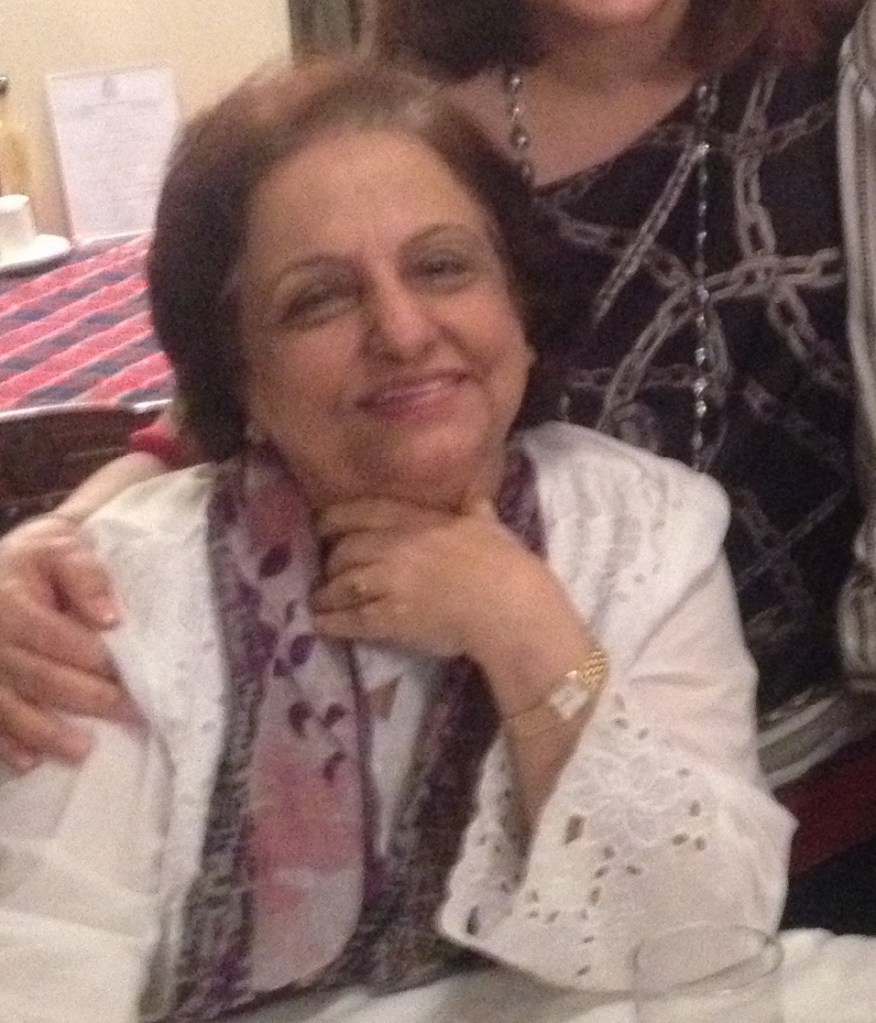
A little about me:
I was born in Hyderabad Sind (undivided India) into an well known family known
as the Khianis!
My venturesome ancestors had migrated to the Canary Islands to try their
fortune and my parents took me there while I was an infant.
Born and brought up in a predominantly western atmosphere. I grew up totally
westernised in my thoughts and outlook.
Probably the biggest tragedy in my life was the loss of my father when I was
only 4 years old.
But now I see that tragedies also have a purpose and had that not happened,
my life would not have taken the turn that it did. Mother would have not brought
me to India.
As a friend said: ” everything is heavenly sent, everything for the higher good “
While in Spain, It was in 1955 that I was enrolled in to a Spanish Catholic
School run by Dominican Nuns. As luck would have it. I was the only Hindu girl
in a class of over 40 Spanish students.
Denied access to our rich cultural heritage. I could not meet my classmates in
discussion when they wondered aloud how Hindus could be so pagan as to
worship cows, monkeys and elephants. It was, perhaps, this humiliation, of
which I was a victim, which sowed the seed in my mind to know and delve deep
into the Hindu philosophy!
I prayed to my best friend then Jesus Christ to show me the way.
I felt that Hinduism, being such an ancient religion, and still thriving, must be
having good reasons for its beliefs…(subsequently I wrote ‘Hindu customs and
beliefs, which explains all that I had yearned to know and understand. The book is up on my website shakunkimatrai.com for free download and perusal)
and God
works in wondrous ways, my father left the world and my mother, a spiritually
inclined lady embraced India.
And it was in Bharat that I was reborn … And my new life was to take me
through a fascinating winding road of Spirituality!
5
I was always told that talking about miracles in life was not encouraged …but my guru’s guru encouraged my guru to share for the benefit of some who may believe and may be on the path… so i believe in sharing…and if you believe what i say, it may increase your faith in the Lord…The unseen hand in creation !
So here goes one of my experiences:
Let me narrate to you how I was unmistakably protected by The Lord.
I was returning from a party with a few friends and I was wearing some of
my choicest jewels. We were on a deserted road when the car was
suddenly surrounded by goons who had nothing good on their mind.
There is little we could do except lock the doors to buy some extra
time…suddenly i shouted: ‘Leave us alone !’ And they retreated much to
our amazement! Who was it who shouted through me? I couldn’t have
been the source of their fear! I look nothing like Madam Dracula or
Superwoman! Who could it be except Hanuman or Krishna? Or God who you may call by any name you may have faith in?
6
If I were asked what I thought the message of the Geeta was in a sentence,
I would say: “Do your best, and leave the rest”.I have always believed that once one puts all efforts towards any cause to the best of ones capacity, one is a winner, no matter what the consequences.
Krishna, in the Bhagavad Geeta states the above, in a more complicated way, in the 47th verse of the 2nd Chapter.A lot of people believe that Spiritualism is for those, who seek an escape from life. If that is so, why is Krishna urging Arjuna to fight for what is rightfully his? Does not that mean that life was not meant for escaping to the hills but to face up to life’s challenges?However one must remember that Krishna tried his best to bring about a reconciliation between the warring cousins, Also Krishna’s message was directed to a soldier whose dharma (roughly translated as duty) was to defend his integrity, and the honor of his wife, on whom an attempt had been made to disrobe in public.
7
I, Shakun agree when friends tell me that they went to Satsangs but lose interest as half of the words go above them.
My suggestion , surely watch in english if that is your preferred language , however when I watch shows / news and they speak some words or something that I do not know about, or that I do not understand , I pause the tv and ask Google for the meaning, or what they are talking about 🙂 …for those who are really interested , to understand lectures in Hindi they could start by watching some lectures in Hindi on tv, pause the tv and ask google the meaning … many of you know that when I came from Spain as a young teenager, I knew very little English and hardly any Hindi. Google was non existent .
But I guess as I have said before God helps those who help themselves…
Dear readers , I am so happy that you have persevered in reading the notes that I share with you every morning, ( this is also addressed to an interactive chat group that I have) but my knowledge is limited. It would be wonderful and it would please me immensely if you went deeper into the subject of spirituality devoting a little time in listening to good speakers…I can only be a stepping stone for you… 🙂🙏❤️
8
A friend has asked:
Why is Gothra Important
In many traditional prayers and sankalpas?
Answer: A gotra is important because it identifies a person’s ancestral lineage, traditionally traced through the male line to an ancient rishi.
Traditionally, many gotras are associated with particular rishis for example, Kashyapa, Bharadwaja, Vashishtha, Gautama, Atri and others.
When you say your gotra during a ritual, you’re essentially saying: “I am this person, of this ancestral lineage, performing this act.”
This is particularly prominent in a sankalpa, where the priest identifies the person along with things such as name, lineage, place and the occasion. It makes the ritual specific rather than simply “a prayer for somebody.”
Gotra also historically had a social and marriage function. In many traditions, people belonging to the same gotra were regarded as sharing a common ancestral lineage and therefore marriage within the same gotra was avoided.
A gotra isn’t the same thing as caste. Two people can belong to the same broad caste/community but have different gotras; conversely, gotra is primarily a lineage identifier.
But there is a deeper philosophical question hiding underneath it.
If you think in terms of Vedanta, the Atman doesn’t have a gotra at all. The Self is neither Brahmin nor Kshatriya, neither male nor female, neither Indian nor anything else. Gotra belongs to the individual’s embodied, social and ancestral identity, not to the ultimate Self.
9
Happy Diwali: For Puja Vidhi scroll up to the previous note .
So this Diwali, as you shop for Diyas, and light diyas , ponder upon its flame’s spiritual nature. It will not only beautify and brighten your home, but will remind you of the transformations that it is meant to bring within.
Diwali falls during a dark period of a year. While most of us pray during this time, negative practices are also prevalent during this time. The best way to dispel negative influences is to light candles, or as is the practice amongst us Hindus, Diyas. Why is the fire worshipped by all the religions in one form or another? Let me share with you what I have learned.
While water finds its level by moving downwards, fire does quite the opposite. Even if you hang a lamp upside down, the flame will rise upwards. Human nature tends to be like water, flowing to lower levels. The flame that we light reminds us to soar upwards.
As one moves forward on the Spiritual path, the darkness of ignorance is replaced by the Light of knowledge. The flame in this case is symbolic of this light which brightens as we journey within.
Tapa stands for fire and penance. Fire destroys the impure. The flame of the fire reminds us of the fact that we should cleanse ourselves of all impurity of our ego and attachments, until only the purity of our soul remains
It is said by Mystics that he who loses his ego will cease to be. The fire rises towards the sky and vanishes.
Not only does the fire vanish as it rises, but after burning the fuel, it becomes silent. Isn’t that what we are meant to become after, burning all our desires and attachments to falsehood?
10
I learned a very nice 2 minute meditation which I would like to share with you this Diwali.
Close your eyes take a few deep breaths until you feel relaxed.
Imagine yourself in the center of your house.
Now ‘see’ the walls expand and the ceiling disappear.
See MahaLaxmi standing above you in all Her Glory!
She is showering you with wealth, health, happiness and anything else that your heart desires. Look at Her and thank Her.
Then gradually allow the walls and the ceiling to return to position.
Open your eyes when you are ready.
May the Goddess bless you this festive season!
Happy Diwali!
11
Talking about life , we had an interactive session on the Geeta… here is the link :
https://shakunkimatrai.com/geeta-little-by-little/
The lessons are for those who have no idea about the Geeta, but you just start reading after the lessons… if you are familiar with the Mahabharat and some more facts 🙏
12
I have shared the Bhagavad Gita, little by little, through the link above.
If you haven’t explored it yet, I would encourage you to do so. Understanding the Gita can give us a wonderful perspective on life and help us navigate its many challenges.
Have you ever wondered why Krishna is called an Ashtadasha Kala Sampoorna Avatar, or an incarnation complete with eighteen qualities or forms of excellence, as traditionally understood?
Krishna is fascinating because he represents so many dimensions of life. He can sing, dance, laugh, love, guide and, at the same time, speak of the deepest truths of existence.
And where does he share this profound wisdom? Not in a quiet forest or an ashram, but right in the middle of a battlefield!
That battlefield is also symbolic of our own lives. We all face conflicts, confusion, difficult choices, relationships and moments when we don’t know what to do.
Perhaps that is why the Bhagavad Gita remains so relevant. Krishna doesn’t ask Arjuna to run away from life. He teaches him how to face it with clarity, wisdom and the right understanding.
If you are already familiar with the Mahabharata and some basic aspects of Hindu philosophy, please feel free to skip the introductory lessons in the link and go directly to our interactions and discussions.
The idea is not simply to read the Gita, but to see how its wisdom can become part of the way we live.
Let’s explore together. 🙏❤️
Click on link above
13
Mumbai mein Bas ek hi gam hai , harek ke paas ek kamra kam hai 😊
Yet
Jesus said: Man does not live by bread alone …
And
Aur bhi gum hain zamane mein mohabbat ke sivaay …
Think about it what is your take ?
14
My take on above :
I feel all three statements hold some truth. For some people, one may be more relevant than the others, and for others, it may be a combination of all three. Our needs and priorities differ at different stages of life.
Maybe the real question is: What is it that we feel is missing from our lives, and how much importance do we give it? 😊❤️
“If you look at these statements through the lens of Vedanta, perhaps the question changes. Vedanta reminds us, that what we think we lack, may not necessarily be what we truly need.
Much of our dissatisfaction comes from identifying happiness with things outside us.
Yet, we must als acknowledge that we live in the world, with its very real needs and desires.
Perhaps the art is to enjoy what life offers without making our happiness entirely dependent on it.”
Was the last part too tough to understand? Read it again , it will become clearer 😊🙏
15
BHAKTI and VEDANTA
The journey begins with I love God and eventually asks Who is this God, and who am I?
Vedanta doesn’t mean that Bhakti or worship is inferior or that we must abandon it. It takes us into an inquiry about the very nature of existence.
The Vedas initially introduce us to worship, rituals and devotion. Vedanta takes us further and asks:
Who am I?
What is the ultimate reality?
Is the individual self separate from the Divine?
This is one of the fundamental inquiries of Vedanta: Who am I?
Let’s start with something very simple.
We say:
My hand – therefore, I am not merely my hand.
My body – therefore, I am not merely my body.
My mind – therefore, I am not merely my mind.
My thoughts, my emotions – I can observe them, so I am not simply the thoughts or emotions themselves.
Then comes the question:
If all these belong to me, who is this ‘I’ to whom they belong?
Vedanta invites us to investigate this.
Will speak about more about this 🙏 let’s see
The hand moves, but chalane wala koyee aur hai 🙏😊
16
Both Bhakti and Vedanta are important. Neither is complete without the other.
There is an interesting analogy I have heard: Bhakti is blind, while Vedanta is lame. Bhakti has the enthusiasm and the love to walk, but cannot see the way. Vedanta can see the way but cannot walk. So, if Vedanta, who is lame, climbs onto the shoulders of Bhakti, who is blind, they can help each other reach their destination.
But I would like to make one distinction: Bhakti is not really blind. She becomes blind only when devotion is driven by fear and superstition.
For example: “Oh dear! I forgot to light the agarbatti today. God will be angry with me!”
I honestly believe God has better things to do than get angry because we forgot to light an agarbatti! 😊
True Bhakti comes from love, faith and surrender, not fear. And Vedanta gives that love the understanding and wisdom to go deeper.
Bhakti gives us the love to reach God; Vedanta helps us understand the very nature of the Divine. Both can walk together towards the same destination.
17
Bhakti :
We all know how to love, but I believe there are different dimensions of love.
The first is ordinary, conditional love: “You scratch my back, and I’ll scratch yours.” There is an element of give and take. We love, provided our expectations are met.
The second is the intense, almost mystical love of Laila and Majnu or Romeo and Juliet. It is a love so deep that even when the two are physically far apart, the pain or suffering of one is felt by the other. It goes beyond ordinary attachment.
The third is a completely different kind of love – love without conditions, expectations or demands. It is total surrender.
Think of Radha’s love for Krishna or Meera’s devotion when she says:
“Jahaan bithave, tahi baithoon, jo de soyi khaaun.”
Wherever You ask me to sit, I will sit; whatever You give me, I will accept.
This is the essence of Bhakti. It is not about bargaining with God or expecting Him to fulfil all our wishes. It is about loving, trusting and surrendering completely.
And, in my own simple words, perhaps this surrender can be expressed as:
“Do your best and leave the rest to Him.”
18
And this one from my various notes that I wrote over the years …
All the water in the world , however hard it tried , could never never sink a ship , unless it got inside …
The Live Oak
Similarly, the negativity around us — or even within us — cannot bring us down unless we allow it to enter and take over our minds.
Anger, jealousy, resentment and hurt are natural human emotions. We cannot always prevent them from arising, but we can become aware of them without allowing them to control us.
The moment we recognise a negative emotion, we have a choice: we can acknowledge it, understand it and let it pass, rather than hold on to it and allow it to poison our thoughts and actions.
We cannot always control the water around our ship, but we can learn not to let it enter.
I particularly like this analogy because it doesn’t ask us to become emotionless or pretend that negativity doesn’t exist.
It asks us to develop awareness.
And that, is very much in keeping with the Vedantic idea of being the observer rather than becoming entangled in every passing thought and emotion.
19
There is hardly any instance when someone attacks or hurts as a result of malice. If there was an intention to hurt, it was a result of some deep rooted unhappiness in the other person.
20
People often tell me, “I have read so many spiritual books, but I don’t remember most of what I have read.”
I ask them: “Do you remember everything you ate last week? Do you remember what you ate a year ago?”
Probably not. Yet the food you ate nourished your body and contributed to the health you enjoy today.
Spiritual reading works in much the same way. You may not remember every teaching, every sentence or every example, but something stays with you. It quietly shapes your thinking, influences your responses and changes the way you look at life.
Just as food nourishes the body even when we don’t remember what we ate, spiritual wisdom can nourish the mind and soul even when we cannot recall everything we have read.
Don’t worry too much about remembering every word. Allow what you read to become a part of you. Its real value lies not in how much you remember, but in how much it transforms you.
21
I believe that the best investment in life is to invest in oneself .
Everyone and everything may leave you but you will live with yourself until the end of your days … also all the organs of your body may fail but your breath will remain until your last breath … so breathe , meditate because your breath will remain your most loyal friend … And after having done one’s best to leave the rest !
My husband was a good man , he taught me how to be independent. He encouraged me to to travel by myself , not only that but if I was going to a far off place, to drop in , in a destination on the way, that I had not visited earlier .
He encouraged me to write , to sing…
I have lived a full life, and now I live for myself… I have done my bit… sometimes sadness comes, but it comes for everyone in different chunks… and here I am happy to sing with my ‘Singing Sakhees ‘ moon ta pahenjo baar babla tote vidho aahe, befikar maan aahyaan , mukhe parva paaiya ji nashe… means : Now Oh Lord, I am un afraid because I place my worries ( my burdens) on You !
22
The Lord told a man to push the entrance to a cave…The man pushed and pushed but was unable to open the entrance to the cave. Dejected he admitted his defeat to the Lord. The Lord said: “I told you to push the entrance to the cave, the opening of the cave, I shall do! And as far as your defeat goes, have a look at the muscles you have built!
Again it says : Do your best and leave the rest 🙏
23
A mantra to repeat when worry does not leave you :
Krishnaya Vasudevaya,
Haraye Parmatmane,
Pranata klesh naashaya
Govindaya namo namaha
Meaning:
Repeated salutations to Lord Krishna, Hari, and Govinda, the destroyer of sorrows for those who surrender.
24
A mantra to repeat when worry does not leave you :
Krishnaya Vasudevaya,
Haraye Parmatmane,
Pranata klesh naashaya
Govindaya namo namaha
Meaning:
Repeated salutations to Lord Krishna, Hari, and Govinda, the destroyer of sorrows for those who surrender.
25
A pregnant woman looks beautiful and so does a bald man who looks after his family
I think that it is an interesting observation…seeing beauty beyond physical appearance.
A pregnant woman carries the visible promise of life. There is something deeply moving about that.
And a bald man who looks after his family? Perhaps seeing the beauty of responsibility, affection and commitment.
His appearance becomes almost irrelevant.
In both cases, beauty seems to come from something life is doing through that person, rather than simply how that person looks.
But there’s a deeper thought behind my comparison.
…beauty is not merely something we see, but something we recognise? ❤️
Think about it!